

Headline net worth figures only tell half the story. The more interesting question behind Jelly Roll Income is how the money actually flows in — show by show, stream by stream, deal by deal. In 2026, Jelly Roll operates like a diversified entertainment company: touring juggernaut, streaming earner, TV personality, and hospitality entrepreneur all at once. This article breaks down each of his income streams, with an estimated annual breakdown at the end.

Touring: The Engine of Jelly Roll Income
For an artist of Jelly Roll’s stature, live performance is the single biggest paycheck — typically accounting for the majority of annual earnings. His touring résumé since breaking through is formidable:
Backroad Baptism Tour (2023) — his first major arena run; most dates sold out, establishing him as a top-tier live draw.
Beautifully Broken Tour (2024) — moved more than half a million tickets, a milestone that placed him among country’s elite touring acts.
Ongoing 2025–2026 dates — continued arena and amphitheater runs, including festival headline slots.
Industry reporting puts his booking fee in the starting range of $1.5–2 million per show. After splitting grosses with promoters, crew, opening acts, and venues, his personal take-home per night is still enormous — and with dozens of dates per year, touring alone likely contributes the lion’s share of his estimated $3 million-plus annual income. One structural headwind: his criminal record has historically restricted international touring (he only recently obtained a passport and had to cancel a London date), leaving significant overseas money on the table for now.
Merchandise: The Quiet Multiplier
Tour merch deserves its own mention. Arena-level country artists routinely generate six figures per night in merchandise sales, and Jelly Roll’s deeply loyal fanbase — many of whom identify personally with his redemption story — are enthusiastic buyers. Branded apparel, vinyl, and accessories sold at shows and online add a meaningful high-margin layer on top of ticket revenue.
Music Royalties: Streaming, Sales, and Radio
Jelly Roll’s catalog is a royalty machine built on emotional blockbusters:
Streaming — “Save Me,” “Need a Favor,” “I Am Not Okay,” “Halfway to Hell,” and “Amen” have each accumulated hundreds of millions of streams across platforms. At typical per-stream rates, catalog streaming alone generates a steady seven-figure annual sum.
Album sales — Whitsitt Chapel (2023) and Beautifully Broken (2024) both performed strongly, with the latter winning the 2026 Grammy for Best Contemporary Country Album, which typically triggers a sales and streaming bump.
Country radio — multiple chart-topping airplay singles produce ongoing performance royalties every time they spin.
Songwriting — as a writer or co-writer on his material, he collects publishing royalties on top of recording royalties, effectively getting paid twice for his hits.
Television, Media, and Appearances: A Growing Income Stream
Jelly Roll has parlayed his charisma into screen work that pays well beyond music:
Theme song for the rebooted American Gladiators — writing and performing a network theme is a prestigious, well-compensated gig with backend royalties.
WWE appearances — his crossover spots with WWE tap into a massive audience and come with appearance fees.
Award shows and TV performances — Grammy performances and televised specials carry appearance fees and enormous promotional value.
Podcast and interview circuit — while not directly huge paydays, his constant media presence (including appearances connected to wife Bunnie XO’s Dumb Blonde podcast empire) keeps his brand hot, which feeds every other revenue stream.
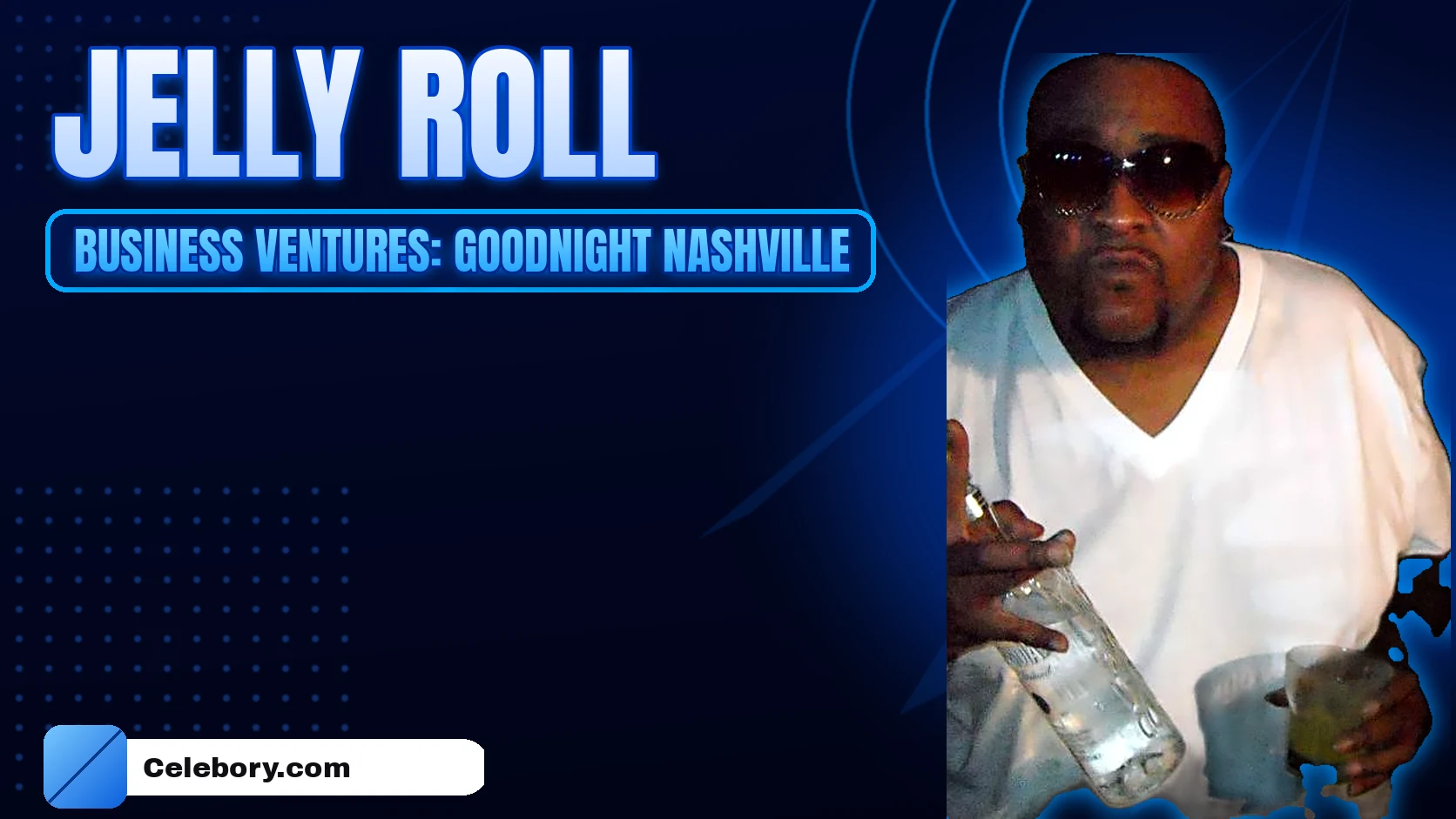
Business Ventures: Goodnight Nashville and Beyond
Like many Nashville stars, Jelly Roll has moved into hospitality. His bar venture Goodnight Nashville plants his flag in the city’s booming Broadway entertainment district, where celebrity-branded honky-tonks are proven moneymakers. While private businesses don’t disclose revenue, comparable artist bars in Nashville generate millions annually in food, beverage, and event income.
He has also shown interest in mentorship and production — using his platform to elevate emerging artists — which could evolve into label or publishing ventures down the line. For now, hospitality remains his most visible non-music business.
Brand Deals and Endorsements
Jelly Roll’s endorsement portfolio is selective but authentic to his image: partnerships tend to center on working-class and heartland brands rather than luxury fashion houses. His dramatic weight-loss journey (down 200+ pounds through training and discipline) has additionally made him an attractive partner for fitness, wellness, and lifestyle brands. Exact deal values are private, but for an artist of his profile, endorsement income likely adds a solid six-figure-plus annual sum.
Estimated Jelly Roll Income Breakdown (2026)
No public figure discloses a payslip, so this Jelly Roll Income estimate is an educated guess based on touring data, industry fee reports, and his net worth trajectory:
These Jelly Roll Income estimates align with the $3 million-plus annual earnings implied by his net worth doubling from ~$12 million (2024) to ~$20 million (2026), as reported by Celebrity Net Worth.
Sources: Estimates compiled from Parade.com, CelebrityNetWorth.com, and Yardbarker/Men’s Journal (2026). Booking-fee figures per industry reporting cited by Parade.
Could His Income Grow Further?
Two factors could push Jelly Roll Income materially higher. First, international touring: if travel restrictions tied to his record continue to ease, European and other overseas markets represent largely untapped revenue. Second, catalog maturation: as his hits age into modern classics, publishing royalties compound. The main risk is the ongoing divorce proceedings (filed May 2026), which could redirect a share of future income depending on settlement terms — something to watch through the rest of the year.
Social Media and Content Revenue
With tens of millions of followers across TikTok, Instagram, and YouTube, Jelly Roll’s social platforms are a business in themselves. Viral clips — tour moments, candid confessions, fitness updates — routinely pull millions of views, generating ad revenue on YouTube and lucrative sponsored-post deals on Instagram and TikTok. His authenticity-first content style (long captions, unfiltered videos) drives engagement rates far above the celebrity average, which is exactly what brands pay a premium for. While this slice of Jelly Roll Income is smaller than touring, it is high-margin, always-on, and feeds directly into ticket and merch sales.
The Grammy Effect on Earning Power
Winning two Grammys in 2026 did more than decorate his shelf — it raised his price. Industry precedent shows major award wins typically lift booking fees, sync-licensing demand, and brand-deal rates by 15–30%. For Jelly Roll, the Best Contemporary Country Album trophy for Beautifully Broken also triggered a measurable streaming resurgence, proving that prestige and profit move together at his level.
Songwriting and Publishing: Getting Paid Twice
One of the most underrated parts of Jelly Roll’s income is that he writes his own hits. As a credited songwriter or co-writer on his material, he collects publishing royalties every time a song is streamed, sold, played on radio, or licensed — on top of the recording royalties he earns as the performing artist. That double-dip is the difference between a singer who gets paid once and a songwriter-artist who gets paid for decades. Performance rights organizations collect these royalties globally, meaning even his oldest independent-era songs still generate income every quarter. For catalog valuation purposes, songwriter-artists command a significant premium — which is part of why his overall fortune has compounded so quickly.
Streaming Income: A Closer Look at the Numbers Game
Streaming economics reward exactly the kind of catalog Jelly Roll has built: a handful of massive, evergreen hits that never stop spinning. With flagship songs each sitting on hundreds of millions of streams, even modest per-stream payouts — industry estimates typically cite fractions of a cent per play — aggregate into a serious annual sum when multiplied across billions of cumulative plays. Three dynamics work in his favor: catalog depth (two decades of releases still earning), playlist placement (his ballads are staples of country and mood playlists), and the Grammy bounce — his 2026 wins triggered measurable streaming surges across both albums. Unlike touring, this income arrives whether he is on stage or asleep, making it the most passive pillar of his finances.
YouTube: The Visual Royalty Engine
YouTube deserves separate mention. His official music videos — particularly for “Save Me” and “Need a Favor” — have amassed hundreds of millions of views combined, and YouTube’s ad-revenue share pays creators on every one of them. Add in lyric videos, live performance clips, and fan uploads (which still generate revenue for rights holders through Content ID), and the platform functions as a 24/7 income stream that doubles as his most effective marketing channel. For an artist whose breakthrough was inherently visual and emotional, YouTube has been both ATM and amplifier.
The Real Cost of Touring: Where the Income Goes
A $1.5–2 million booking fee sounds like pure profit — it is anything but. A modern arena tour is a traveling company: Jelly Roll’s operation employs dozens of people — band, crew, sound and lighting engineers, tour managers, drivers, security, and merchandise staff — plus a fleet of buses and trucks, venue rentals, insurance, and a stage production worthy of an arena headliner.
The industry rule of thumb holds that production and personnel can consume half or more of gross tour revenue before splits with promoters. What reaches the artist is still life-changing money, which is why touring remains his biggest income pillar — but the gap between the headline fee and the take-home check is one of the least understood parts of music economics.
Future Income Catalysts
Looking ahead, four levers could materially grow his annual income:
International expansion — Europe, the UK, and Australia represent essentially untouched markets; even a modest overseas run would add an entirely new tier to Jelly Roll Income.
Acting and hosting — his natural charisma and WWE crossover suggest screen work beyond music could become a real income line.
Catalog appreciation — as his hits age into modern standards, publishing income compounds; a future catalog sale could be a major wealth event.
Brand elevation post-Grammys — award winners historically command 15–30% higher fees across bookings, syncs, and endorsements.
Conclusion: Jelly Roll Income in 2026
Jelly Roll Income — an estimated $3–5 million in annual income — flows from one of the most diversified revenue machines in country music: arena touring at the core, streaming and publishing royalties compounding in the background, television and WWE appearances expanding the brand, hospitality adding business income, and endorsements skimming the top. Nothing about it is accidental — it is the payoff of two decades of independent grinding colliding with a perfectly timed mainstream breakthrough.
The most interesting part of the Jelly Roll Income story is how much headroom remains. International touring, screen work, and catalog appreciation are all largely untapped, meaning his earning peak may still be ahead of him. For the full wealth picture, see our companion article on his 2026 net worth — and for the life story behind the money, his biography.
Frequently Asked Questions About Jelly Roll Income
How much does Jelly Roll make per year?
Analysts estimate Jelly Roll Income at roughly $3–5 million per year, with touring as the largest component.
What is Jelly Roll’s biggest income source?
Touring and live shows — his booking fee reportedly starts around $1.5–2 million per show.
Does Jelly Roll own any businesses?
Yes — most notably Goodnight Nashville, his bar venture in Nashville’s entertainment district.
How much does it cost to book Jelly Roll?
Industry estimates put his starting booking fee between $1.5 million and $2 million.
Does Jelly Roll make money from streaming?
Yes — hundreds of millions of streams across his hit singles generate significant annual royalty income, supplemented by publishing royalties as a songwriter.
Photos: Setoxxx / Wikimedia Commons (CC BY-SA 4.0); 7EVENSIQS / Wikimedia Commons (CC BY 3.0); public domain photo via Wikimedia Commons.

The Celebory Editorial Team is dedicated to researching and publishing accurate, engaging, and up-to-date information about celebrities from around the world. Our content covers net worth, biographies, careers, personal life, and lifestyle insights of actors, musicians, athletes, influencers, and public figures. Every article is carefully reviewed to ensure factual accuracy and reader-friendly presentation, making celebory.com a trusted source for celebrity information.